Love is All Around
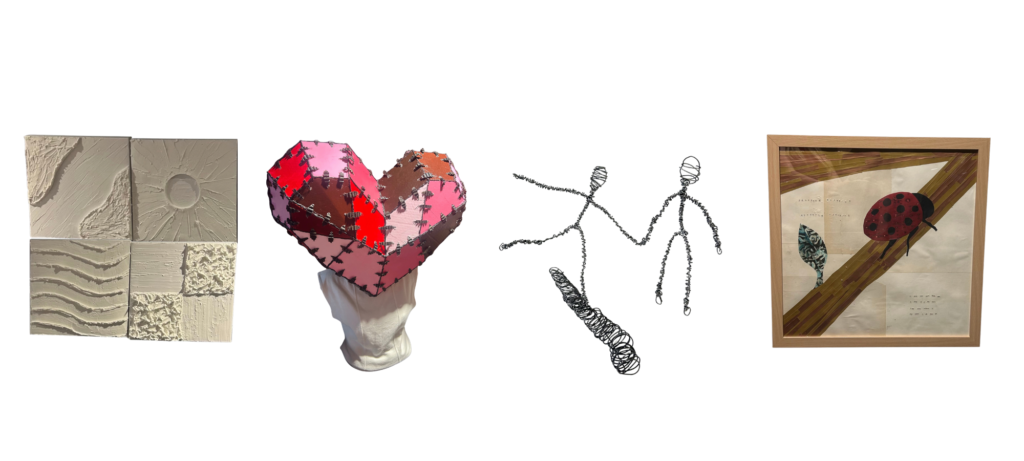
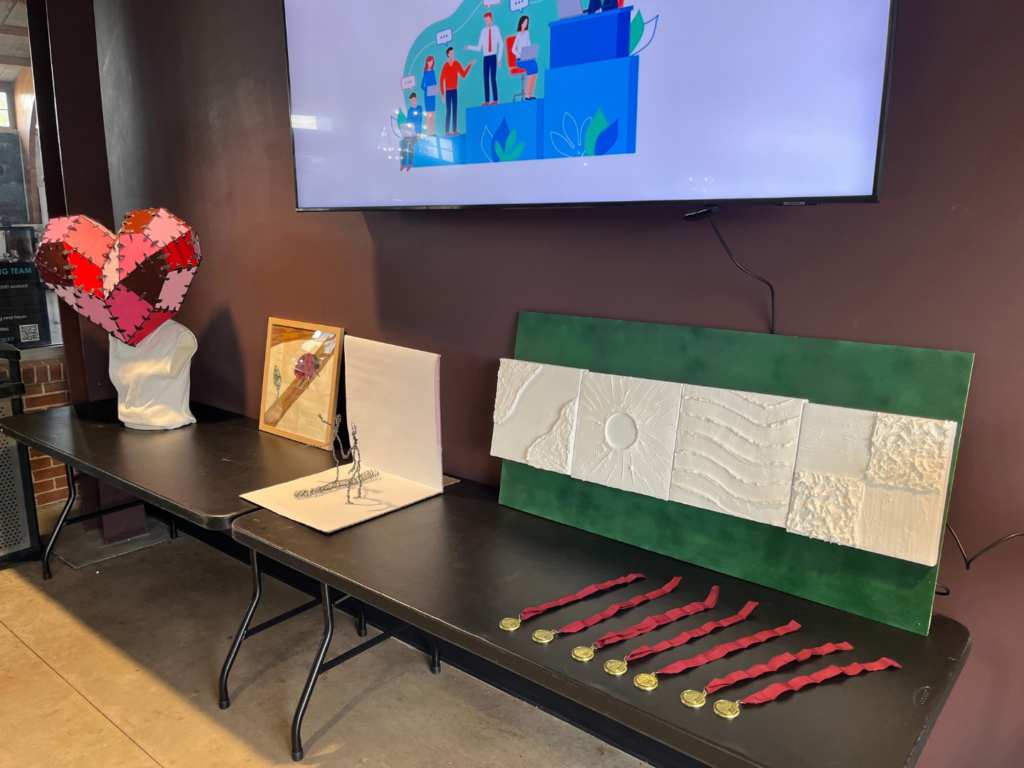
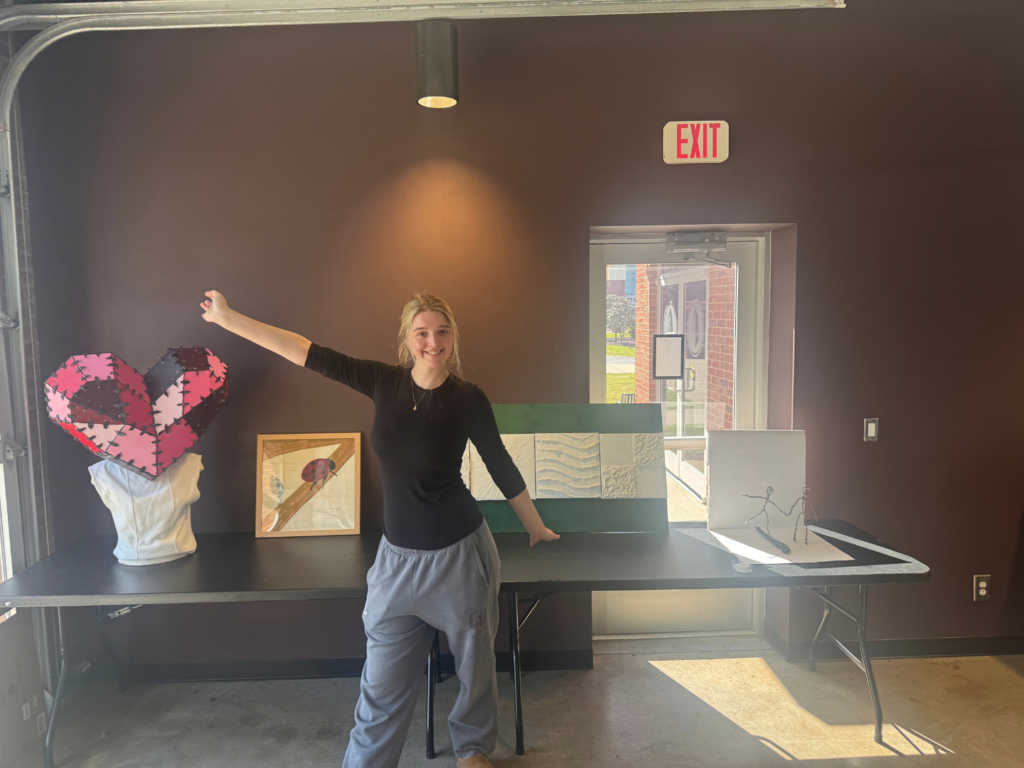
My senior capstone project, Love is All Around, was designed to encourage a combination of research and creation. This capstone contains four pieces of art accompanied by their own written works. Each piece is unique in medium and meaning, but all align with one central theme: love exists everywhere and is deeply complex. Throughout my project I experimented with cardboard, plaster, wire, and paper. In some of the projects, I focused on the artwork and built research around the piece, and in others I used research as my foundation for the piece. This project encouraged me to think harder and find meaning in the little things.
Holding the Pieces Together
BACKSTORY
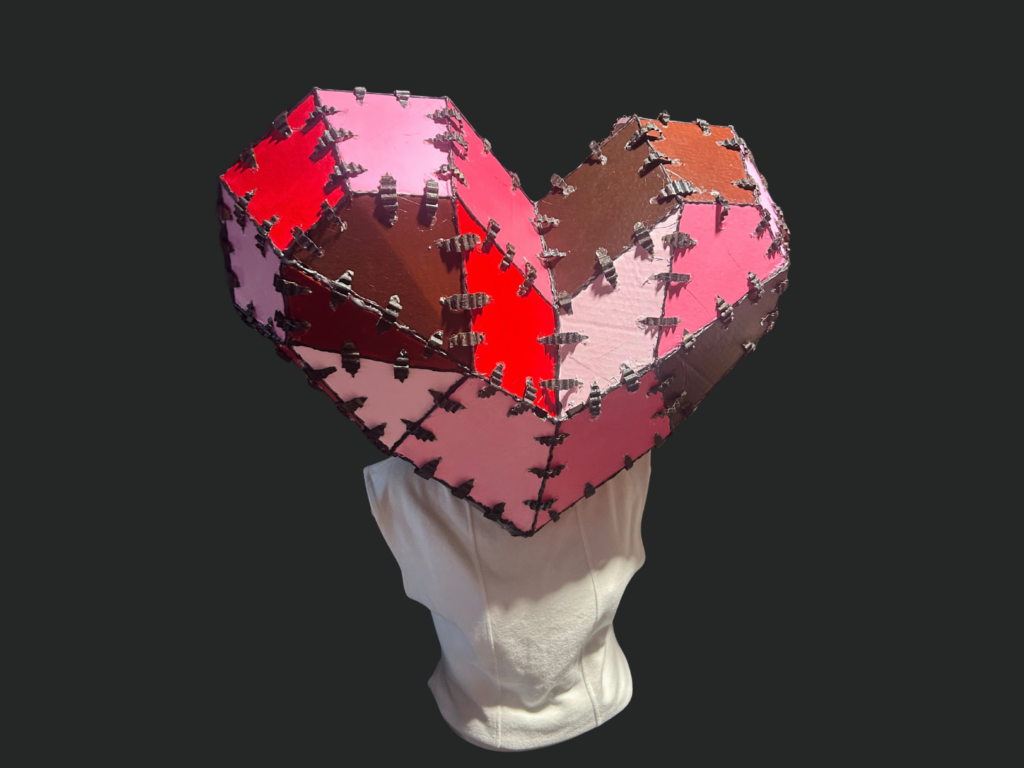
In my Three-Dimensional Design class, we were given the project to create a large mask made entirely out of cardboard, hot glue, and paint. Before beginning our sketches and creation, we were encouraged to look deeply into what a mask meant to us and in society. To me, when thinking of a mask, I think of covering up emotions in an attempt to be stronger: putting on a brave face. In my ideation of this project, I settled on the idea of creating a heart-shaped mask that was geometrically structured, but appearing shattered. When you are masking your emotions and building yourself back up, there is a large concoction of vulnerability, strength, brokenness, and concealing your emotions. I wanted all of this to be felt through this piece.
RESEARCH
Masks have played an important role throughout history in arts, culture, and medicine. When beginning this project, we were asked to decide what a mask meant to us. This meant we had to decide on a direction for what style of mask. Masks have been used to protect our bodies from dangerous diseases and chemicals for centuries. One of the earliest forms of masks in medicine dates back to the Middle Ages, when there was the black plague epidemic (Matuschek et al., 2020). In 2020, the Coronavirus pandemic made masks globally recognized and utilized. In some places, masks are still required on public transportation because of this large-scale outbreak (Matuschek et al., 2020). Masks are also used during surgeries and other medical procedures to protect everyone in the room. In medicinal practices, masks are used as protection.
The other most popular usage of masks is in theatre. Masks have been used in theater productions for centuries, allowing for artists to express themselves and their characters boldly to the audience. Masks became so popular in Ancient Greece, because a set of masks could allow one individual to play a variety of roles in a performance (Backstage, 2024). Masks allow actors to become something elaborate, which is still effective today.
PROCESS
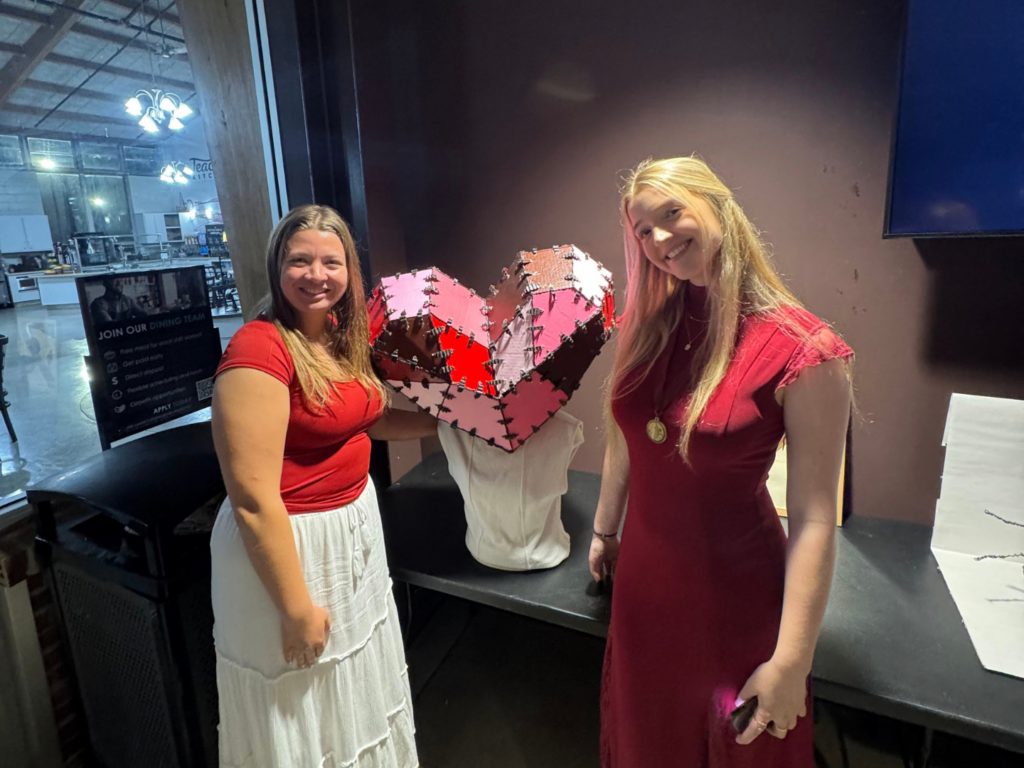
The assignment guidelines required the mask to be at least twenty four inches long, be wearable, and be made of solely cardboard with paint and glue additions. First, this required sketching the overall structure and appearance of the mask on paper. Since the mask needed to be wearable, this required it having a spot to be placed over the head and fit properly. I sketched out my geometric heart and settled on my exact proportions. To ensure I created the correct size, I first created the mask out of paper. On my first try, it ran small, which required me to reevaluate my sizing and create it again. On my second attempt, I got the sizing correct and moved forward. From here, I utilized the measurements I practiced in paper to cut out my cardboard pieces. I then utilized hot glue to piece them together to create my larger mask. On the inside of the large geometric heart, I created a spot for the mask to rest on your head, making it wearable as a true mask. I also cut out discrete viewing holes at the front of the mask. It was important to keep the larger pieces geometric and structured. Next, I created the stitches. I was able to deconstruct the cardboard to create stitch-like pieces. I wanted these pieces to vary and be “messy” across the mask. I utilized hot glue to place the stitches across all of the cardboard connection points. The irregularity of the stitches mixed with the exact measurements of the cardboard pieces created the perfect visual and emotional balance of structure and chaos. The final step was to paint the piece. I leaned into the standard stereotype of “love” and color blocked the geometric pieces of the heart into a variety of reds and pinks. This leaned further into my symbolism of several different pieces being held together. The main focus I had throughout the project was to ensure this remained a wearable mask. It wasn’t just a sculpture, we were intentionally creating masks. I ensured that the piece would balance comfortably on one’s head.
REFLECTION
This project pushed me to explore a style of art that I have never worked with before. Sculptured pieces are magical in communicating emotions with people. Working with cardboard was unique because it is both a strong and fragile material. It required a delicate hand, but resulted in a strong product. This mask reminded me of love because in my most broken moments, it was the community around me that held me back together. Sometimes the path to staying held together is not clean and perfect, but what truly matters is that you are held together. Stitches heal and ultimately, what started as being “masked” will end up being healed.
Childhood Balance
BACKSTORY
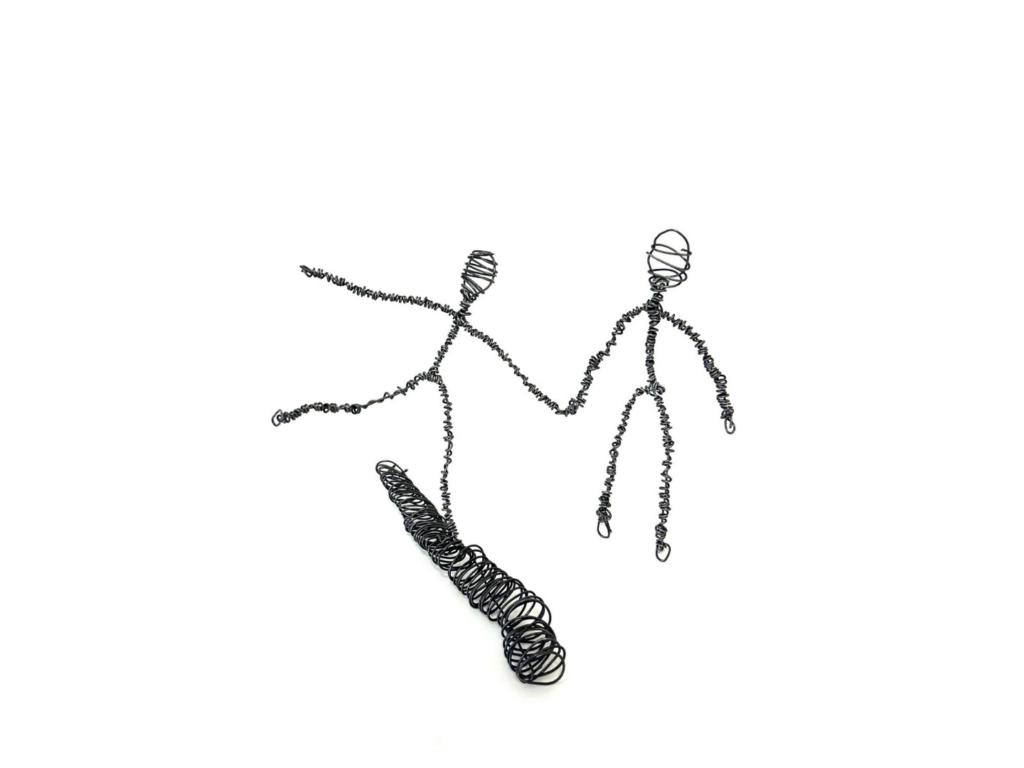
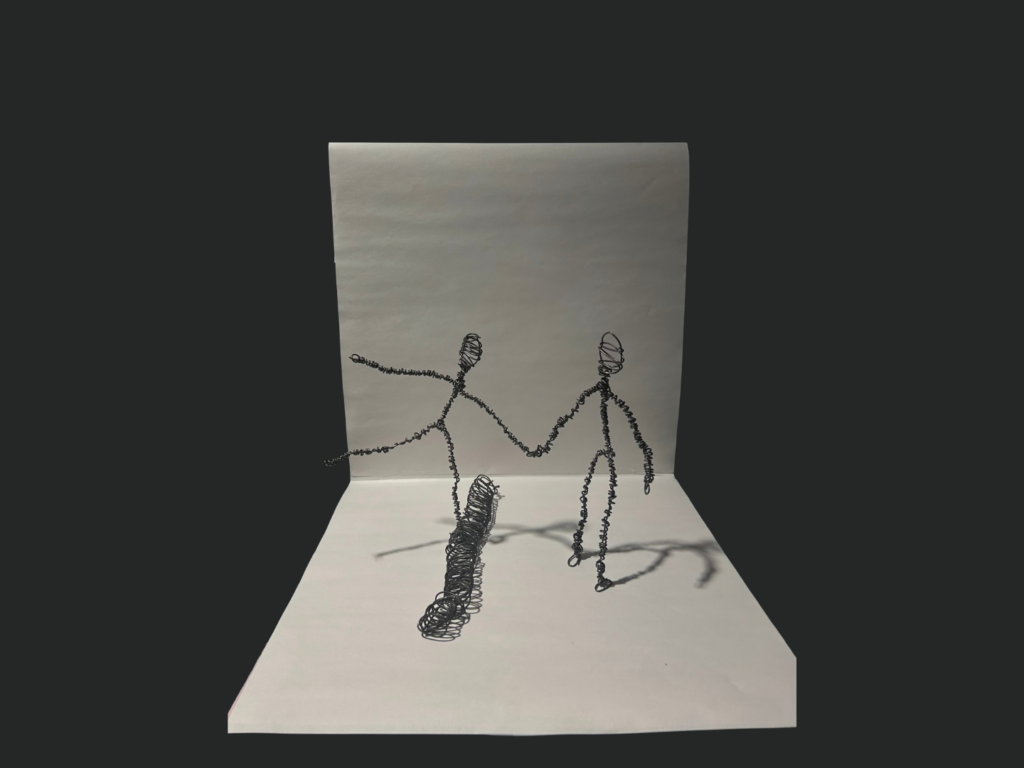
This sculpture represents a childhood memory shared with my brother. This assignment asked students to create a sculpture using wire that captured a meaningful moment from their childhood. Rather than selecting one individual memory, I chose to represent a multitude of consistent occurrences I experienced throughout my childhood. This wire sculpture depicts two figures holding hands while one person walks on a beam, with the other supporting them, balancing them. Throughout my childhood, my brother has always been a strong presence in my life. He influences me and is a role model for many of my decisions. I realize as I have grown up how beneficial his influence on my life has been.
RESEARCH
Wire has been utilized in art and sculpture for centuries. Many famous artists inspired my creation of this piece. Many artists have contributed to the wire art movement (Artelier, 2024). Each artist has their own style of creating these sculptures. Some try to showcase a strong body and convey strength through large portions of wire, while some play into the minimalism of the wire to create transparency in their pieces. One artist who inspired me heavily was Ruth Asawa. Ruth Asawa is famous for her looped wire sculptures (Ruth Asawa Lanier, Inc., 2026). These pieces show such movement in a still object, and inspired my attempts at showing balance and walking in my piece.
PROCESS
In our class discussion of this project, we were instructed to make a wire sculpture that looked like a drawing. The first step in this project was ideology. We were to select a childhood memory. Immediately, I knew I wanted to create something for my sibling, as I was blessed with such a wonderful relationship with him. I thought of all the times he had made me laugh or been there as a shoulder to cry on. This piece perfectly represents both, because him holding my hands provided support, while also giving me the encouragement to have fun. After I had come up with the idea, I then turned to sketching. Since the wire sculpture was supposed to look like a line drawing, I had to be as simple as possible when sketching. Any line I made on paper would be a piece of wire in the piece. I settled on a simplified “stick-figure” appearance, and a simple beam to portray a log, curb on the side of the road, or whatever the viewer instantly connects with.
Creating the wire sculpture was tough, wire is not the most forgiving medium, and it is difficult to isolate one aspect of the piece without adjusting other sections as well. I utilized wire, wire-cutters, and pliers to create this piece. The piece needed to be as minimal as possible, while also being sturdy enough to stand up on its own. Using the pliers, I bent and shaped the wire to form the base outline of each figure. From there, I “filled them in” by surrounding my outlines with more wire to create more thickness. After building the figures, I made structural adjustments to make sure the structure remained stable. Minor adjustments were also made to portray the action that was occurring. The hands and legs were bent at a precise angle to help communicate the idea of balance and support.
REFLECTION
When I shared the creation of this piece with my brother, he told me how much it meant to him and that he needed to hear this more than I knew. Lately, at his job in New York City, he has been working an estimated 100 hour work week, which he shared has forced him to get lost in what he is doing and forget about what really matters. When I shared the meaning behind this piece, he told me “sometimes I’m not sure who is balancing who.” What I absolutely love about this statement is that he didn’t even realize that in the creation of the piece, the two figures had to balance each other perfectly in order for it to not fall over. The wire is delicate, and since I was creating a ‘fine line’ sculpture, it didn’t have much support. Without even realizing it, he had made this piece mean even more than I originally intended. This piece reminded me of two very important things: first, how much art can ground people; and second, that in a valuable relationship, both parties are providing things to benefit the others’ lives. I had always considered all of the good things my brother provided in my life – laughter, inspiration, safety – but had never considered that I too could bring positivity into his life through my artwork.

Where the Branches Meet
BACKSTORY
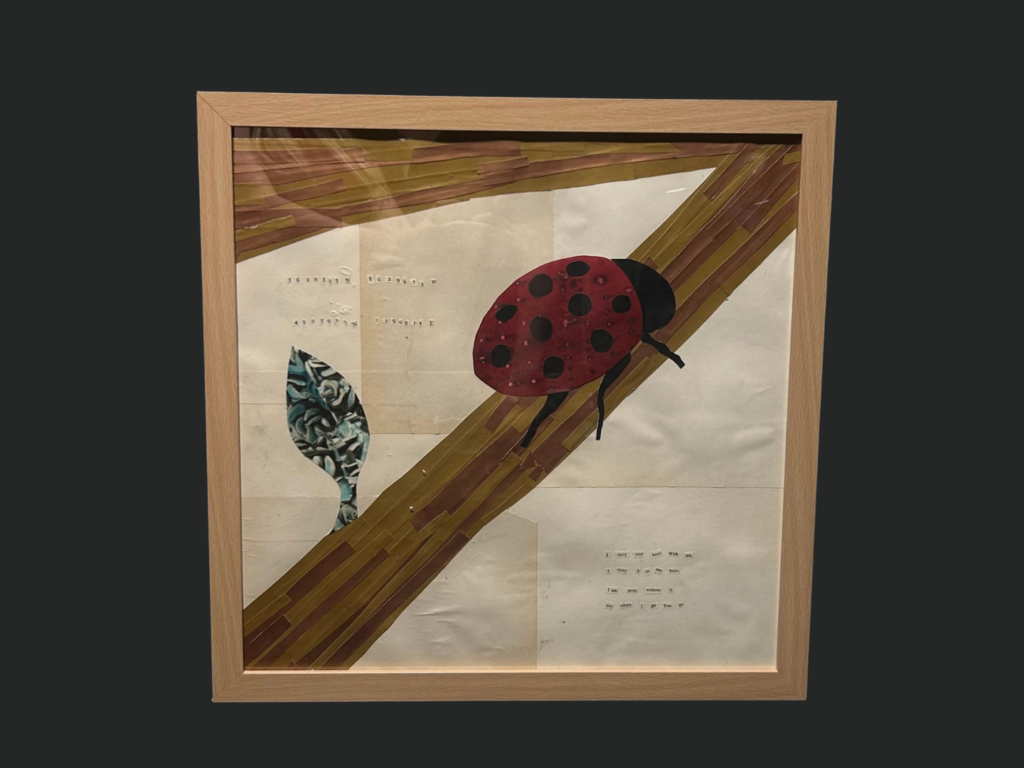
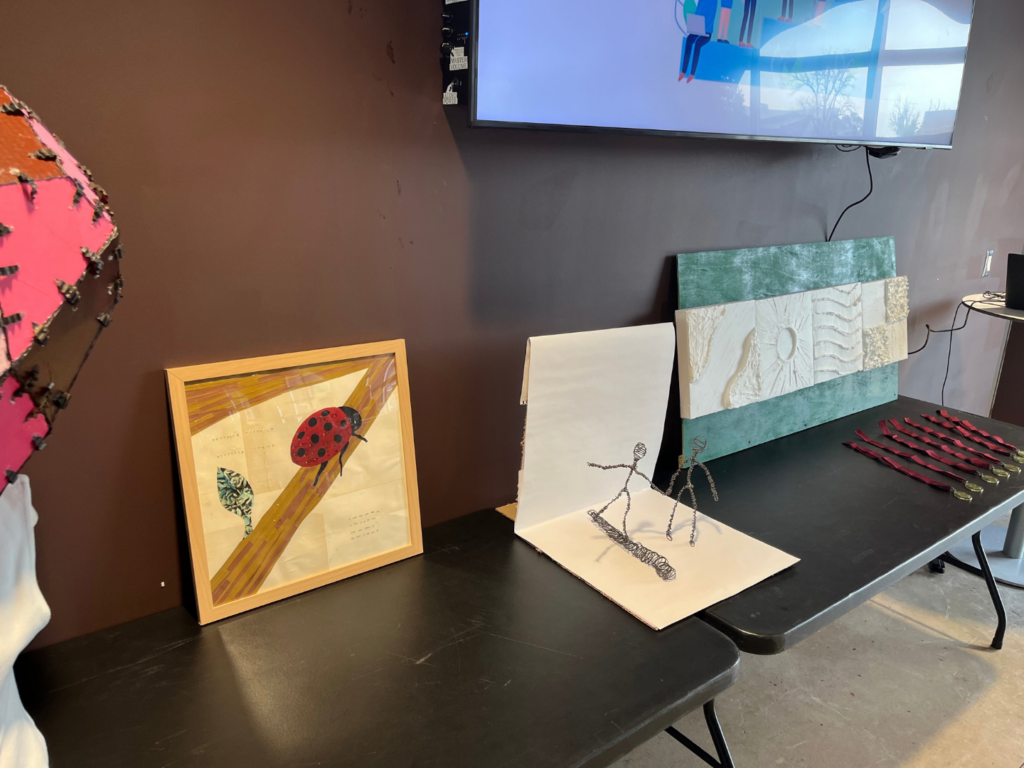
This piece was inspired by one of my greatest forms of love: my significant other, Luke. I have never been at a shortage for love in life, with wonderful friends and family, but when I met him my heart felt an exceptional beaming of love I had never felt before. Luke brings sunshine into my life daily, keeps me steady when I am not, and is the person I plan to spend forever with. Last year, he was deployed to Romania, Greece, and Germany for 9 months as an active duty infantryman in the Army. During this time, communication became something more difficult and meaningful. Letters have always been something we shared, but became pivotal to our connection as it was something physical we could hold of one another. Another form of connection we shared was through ladybugs. I’m not sure when it began, but at some point along the way, any time one of us saw a ladybug we would send a photo and let the other one know we were thinking of them. I created this piece while he was gone as my expression of love for him and gifted it to him as a surprise when he returned.
RESEARCH
One important aspect of this piece was the inclusion of a poem by E.E. Cummings. It goes as such:
“i carry your heart with me(i carry it in
my heart)i am never without it(anywhere
i go you go,my dear;and whatever is done
by only me is your doing,my darling)
i fear
no fate(for you are my fate,my sweet)i want
no world(for beautiful you are my world,my true)
and it’s you are whatever a moon has always meant
and whatever a sun will always sing is you
here is the deepest secret nobody knows
(here is the root of the root and the bud of the bud
and the sky of the sky of a tree called life;which grows
higher than soul can hope or mind can hide)
and this is the wonder that’s keeping the stars apart
i carry your heart(i carry it in my heart)”
The portion that I included was “i carry your heart with me(i carry it in my heart) i am never without it (anywhere i go you go” (Cummings, 1991). I chose to include this text because it provided a unique theme to what my piece symbolized: no matter where we were, we carried one another through our letters, ladybugs, and love.
PROCESS
To build this piece, I spent hours over a variety of magazines and books, selecting which pages and textures would align with my piece best. Additionally, when I decided to incorporate cutout words, I scoured through books finding the exact words I needed. Once I had cutout all of the pieces, I began laying them out and framing the piece. I designed it so that there was a primary focus on the ladybug, who would be traveling up the branch in connection with an additional branch. This connection point symbolized Luke’s return to America. To represent the immense importance of our written communication, I laid the foundation of blank writing paper as my background for the piece. I intentionally laid out the seemingly plain background with cutout words from a book so that this portion of the piece did not stand out above the ladybug. The words and coordinates on the page are personal and meaningful, so to anyone paying attention and giving the piece care, they would be able to read and appreciate it, but it would not stand out from a quick glance. I then glued on the paper how I wished and laid a final coat of adhesive to flatten the work, and framed it.
REFLECTION
This piece is one of my most meaningful works, as it represents a vulnerable time in my life and was a way to translate my deeply emotional experience into a lighthearted piece. This project encouraged my ability to connect with others through my artwork, and connected perfectly with my overall project theme. Love persists through distance, and stands strong through trials. Love is something worth fighting for. Love is made up of a thousand tiny gestures.
Ways We Attach
BACKSTORY
Lately, I have been fascinated with how different forms of movement can portray entire feelings and emotions. Just the direction that a stroke of paint moves in can evoke an emotion of anger, happiness, or sadness. From a plain view, it might seem like some unknown reason that we all are just aware of, but I was interested in focusing on this more. I selected this medium based on its ability to be adaptable and evoke movement so well. Attachment theory is one of the most widely understood and influential psychological frameworks for dissecting and understanding human brains. We use this theory to understand why people grow the way they do, based on hoe they were raised. There are four main styles of attachment in this theory, which are represented through my four panel plaster creation.
RESEARCH
Attachment theory was originally developed by John Bowlby, a graduate from Cambridge University. The way he was raised is actually pivotal to his research, as he was raised primarily by nannies and had 5 siblings (Attachment Project, n.d.). In his childhood he endured a great deal of separation from family, as he grew up through both world wars. He studied psychology in college and spent much time looking after troubled children in his twenties. He remarks that while he worked in the school he “‘learned everything that [he has] ever known’” (Attachment Project, n.d.). Throughout his career, he felt negatively about many of the existing theories on psychology and behaviorism, which inspired him to look deeper into child development. He looked at how long periods of separation from a mother can affect children, and how when children feel this sense of abandonment it often results in them acting out (Attachment Project, n.d.). He took this initial information and expanded to what is now widely known as Attachment Theory.
In my pieces, I wanted to focus on the four attachment styles: Anxious, Avoidant, Disorganized, and Secure. These attachment styles have several different names, Disorganized Attachment is also referred to as Fearful-Avoidant, avoidant Attachment is also referred to as Dismissive Attachment, and Anxious Attachment is also referred to as Preoccupied Attachment. These styles develop in early childhood based on how the primary caregiver acts toward their child and how their relationship is (Attachment Project, 2020).
Anxious Attachment often appears in adults as those with a negative view on themselves, and seeing others as better than them. They do not feel worthy of love, and cling extremely hard to their partner because they legitimately believe they would be worse without them (Attachment Project, 2020). They have an enormous fear of abandonment.
Avoidant Attachment appears in adults in the form of thinking they are better than others, and being ultra-independent. These individuals do not want to feel dependent on others or be answering to others so they make this clear by being distant and suppressing their feelings (Attachment Project, 2020).
Disorganized Attachment is a conflicting attachment style. Individuals want and crave connection, but often push against it because they are fearful of it. This can show up for a multitude of reasons, but typically at some point in their childhood, their caregivers did not meet emotional needs of the child, which left that child unsure of how to share connection (Attachment Project, 2020). These individuals find relationships to be something of desire and also fear as they grow up.
Lastly, Secure Attachment is when someone is completely comfortable in relationships. They share their emotions and receive them well from their partner. These individuals still require honesty and work, but they are not struggling from any negative views on relationships that affect them directly (Attachment Project, 2020). Secure Attachment individuals can be alone or in a relationship, and it does not affect how they look at themselves.
PROCESS
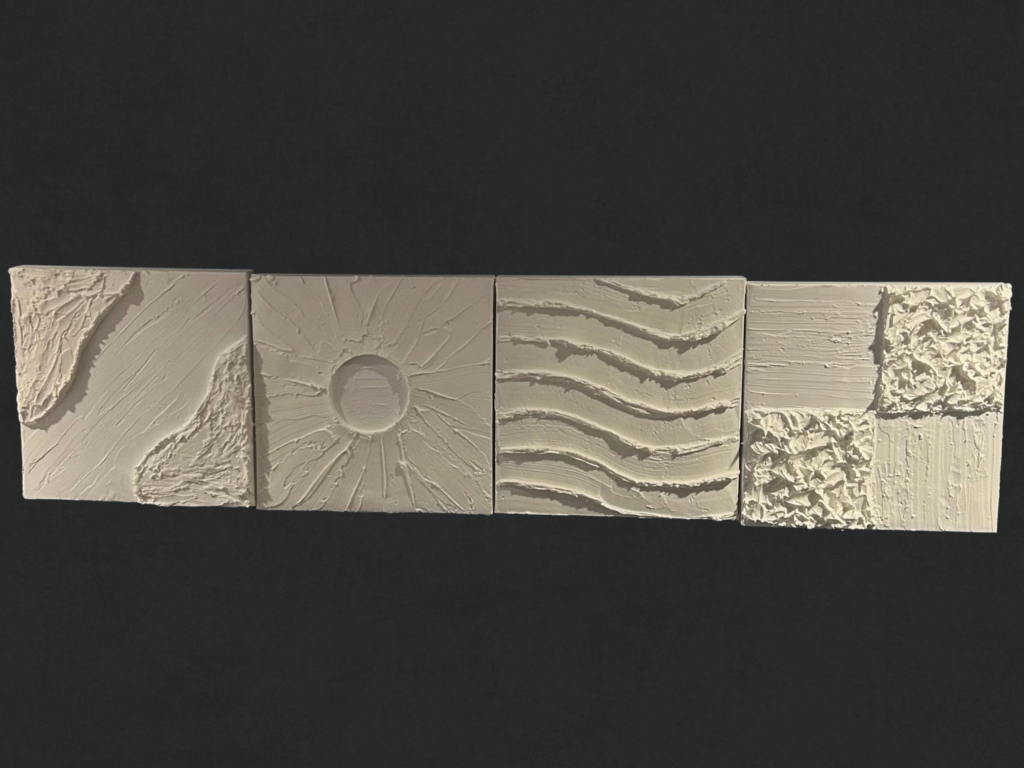
This piece was created by taking 4 identical canvases, plaster and a selection of tools, and creating four unique pieces. Each canvas was originally covered with a thin layer of plaster to set the base, and then built from there. When working with plaster of this kind, you have to be completely invested in one sitting to complete the piece, as the plaster dries fairly quickly. Timing is everything when working with this medium, as the different phases of drying allow you to do different things with it.
Each piece required a different technique in its creation.
The secure attachment piece is represented by cohesive lines flowing in a calming state. This represents how these individuals flow in relationships well with one another.
The anxious attachment piece is represented by a canvas with a gaping absence of the plaster in the center of the piece. Individuals with anxious attachment see themselves as incomplete, thus a gaping absence in their own hearts.
The avoidant attachment piece is represented by a piece with two thick structures on each opposing corner of the piece. These individuals push away from connection because they are fearful of it.
The disorganized attachment piece showcases a canvas with a checkerboard pattern. Two of the checkers are calm and smooth, while the other two are spiked and showing chaos. These movements with the plaster represent the nervous system of an individual with disorganized attachment style.
REFLECTION
This piece was enjoyable to create because I leaned heavily into the research prior to creating the piece. A lot of times with artwork, you research as you go or create meaning after the piece is underway. I was challenged in this piece to educate myself on the attachment styles in order to create an accurate representation of them.
REFERENCES
Artelier. (2024, March 28). 15 ultra cool wire artworks you need to know about. https://www.artelier.com/post/15-ultra-cool-wire-artworks-you-need-to-know-about
Attachment Project. (n.d.). John Bowlby and attachment theory: Insights and legacy. https://www.attachmentproject.com/attachment-theory/john-bowlby/
Attachment Project. (2020, July 2). The four attachment styles. https://www.attachmentproject.com/blog/four-attachment-styles/
Backstage. (2024, July 3). Mask in theater: The history + power of hiding actors’ faces. https://www.backstage.com/magazine/article/mask-in-theater-explained-77455/
Cummings, E. E. (1991). i carry your heart with me(i carry it in. In G. J. Firmage (Ed.), Complete poems 1904–1962 (Rev. ed.). Liveright Publishing Corporation.
Matuschek, C., Moll, F., Fangerau, H., Fischer, J. C., Zänker, K., van Griensven, M., & Schneider, M. (2020). The history and value of face masks. European Journal of Medical Research, 25(1), 23. https://doi.org/10.1186/s40001-020-00423-4
Ruth Asawa Lanier, Inc. (2026). Sculpture. Ruth Asawa website